April 2026, Washington D.C.
During this year’s Spring Meetings, no World Bank Action Day took place on the usual Friday. Why?
For international groups, the current US administration means rapidly shrinking spaces for civil society. To speak up in front of the buildings of World Bank and IWF may have consequences for visas and permits.
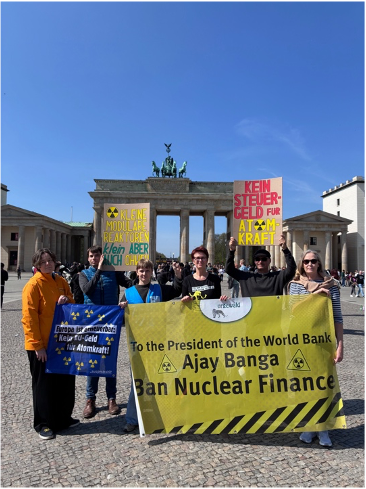
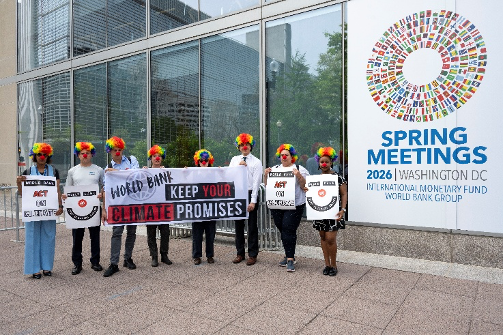
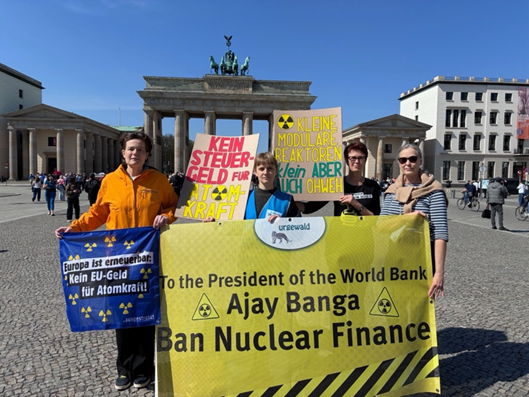
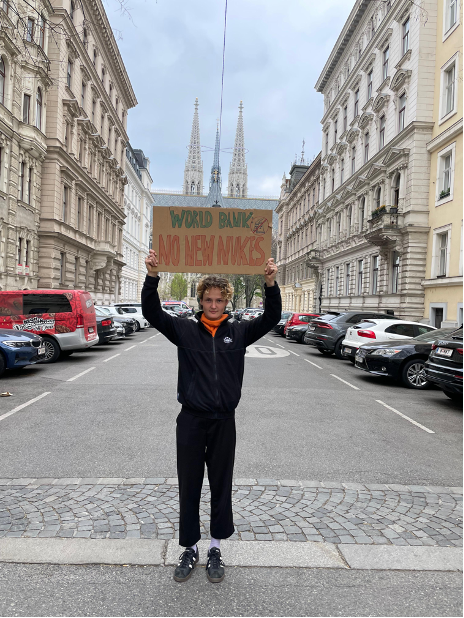
Nevertheless, some smaller protests by Big Shift Global members took place during the week in Washington, D.C. Across the pond, in Berlin and Vienna people gathered to remind the World Bank not to invest in false solutions.
War and Crisis
The Spring Meeting 2026 took place at a moment when geopolitical tensions, and particularly the US/Israeli war on Iran and Lebanon, overshadow the World Banks’s purpose, namely “to end extreme poverty on a livable planet”. Rising energy prices are undermining energy security and disrupting food systems.
Fossil fuel dependency and systems of extraction and exploitation increase global instability and exacerbate the challenges that countries of the Global South face. Much needed funding for a just energy transition flows instead into the growing militarization of Global North countries. At the same time, Official Development Assistance (ODA) is declining dramatically. Existing debt vulnerabilities are worsening. Currently, developing countries face their highest debt levels since the 1990s. Climate, debt and military crises converge across the Global South.
The World Bank repeatedly attempts to portray itself as a neutral actor and thereby shirk its responsibilities. However, theses crises—and in particular Ajay Banga’s role in the Board of Peace—demonstrate that the World Bank’s decisions are never neutral. They are embedded in geopolitics and, in particular, in the interests of its most influential shareholder, the United States. This means the World Bank can never truly be impartial.
World Bank is Throwing Money at Nuclear Power
Last year, under pressure from US President Donald Trump, World Bank President Ajay Banga ended the bank’s moratorium on nuclear energy. This is disastrous. The building of new nuclear energy facilities leads to high debt, lengthy construction processes and dependence on mostly Russian uranium. Nuclear energy is neither a solution to the climate crisis nor a viable strategy for sustainable development. The nuclear lobby is hyping up the so-called small modular reactors (SMRs). However, the nuclear industry is known for never keeping its big promises. SMRs face the same problems as large reactors in terms of technology, risk and radioactive waste – all of which have not been solved to date. On top, SMR electricity would be the most expensive on the market. All these outsized costs and risks are being passed on to future generations.
The future of energy supply lies in clean, renewable, affordable and democratic energy systems. Public financing through the World Bank must follow this path, too.
We call for a return to the World Bank’s mission to fight poverty on a livable planet.